What are the registers?
Introduction
The surviving registers of the Archbishops of York available on this site date from between 1225 and around 1650. They form part of a larger series of volumes held in the University of York’s Borthwick Institute for Archives.
Some registers exist in roll format, such as that of Walter de Gray, Archbishop from 1215 to 1255. The majority of registers exist in book format, like the register of William Melton, Archbishop from 1317 to 1340 (see right), now divided between two volumes (Reg 9A and Reg 9B). They are handwritten in ink, mostly on parchment.
How are they structured?
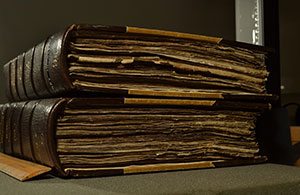
Many of the archbishops’ registers are divided into sections, so that entries relating to similar business are found grouped together (see: David M. Smith, Guide to Bishops’ Registers of England and Wales (London, 1981) and supplement, C & Y Centenary Supplement (2004)). In many cases, a contemporary heading is found at the beginning of each section to identify the contents, but in others, a new section type has been created in our database, using David Smith’s Guide or, if none appears, by adding the term ‘None recorded’. The following is a list of section types applied to the various divisions of registers in the database, with an explanation of the type of business to which they relate.
| Section Type | Contents |
|---|---|
| Admissions, friars | Used for sections in the registers of Archbishop William Zouche (Reg 10, ff. 278-280) and Archbishop John Thoresby (Reg 11, f. 396r) for admissions of friars as penitentiaries or to hear confessions; in Reg 11, particularly for admissions of friars in place of others, many of whom had died. |
| Archbishop Harsnett | Used for a section of Reg 32 for business conducted under Archbishop Samuel Harsnett (1629-1631), as some of the 16th and 17th century registers are divided into sections for entries relating to each archbishop and not to entry type. |
| Archbishop Hutton | Used for a section of Reg 31 for business conducted under Archbishop Matthew Hutton (1595-1606), as some of the 16th and 17th century registers are divided by entries relating to each archbishop and not to entry type. |
| Archbishop Matthew | Used for a section of Reg 31 for business conducted under Archbishop Tobias Matthew (1606-1628), as some of the 16th and 17th century registers are divided into sections for entries relating to each archbishop and not to entry type. |
| Archbishop Monteigne | Used for a section of Reg 31 (ff. 266-272) for business conducted under Archbishop George Monteigne (or Mountain) (1628), as some of the 16th and 17th century registers are divided into sections for entries relating to each archbishop and not to entry type. |
| Archbishop Neale | Used for a section of Reg 32 for business conducted under Archbishop Richard Neale (or Neile) (1632-1640), as some of the 16th and 17th century registers are divided into sections for entries relating to each archbishop and not to entry type. |
| Archbishop Piers | Used for a section of Reg 31 for business conducted under Archbishop John Piers (1589-1594), as some of the 16th and 17th century registers are divided into sections for entries relating to each archbishop and not to entry type. |
| Archbishop Sandys | Used for a section of Reg 31 for business conducted under Archbishop Edwin Sandys (1577-1588), as some of the 16th and 17th century registers are divided into sections for entries relating to each archbishop and not to entry type. |
| Archbishop Williams | Used for a section of Reg 32 for business conducted under Archbishop John Williams (1641-1650), as some of the 16th and 17th century registers are divided into sections for entries relating to each archbishop and not to entry type. |
| Archbishops' visitations and associated material | Used for business relating to the archbishop’s oversight or inspections, known as visitations, of the clergy and people of the province of York, and some religious houses, including proceedings; detection of faults, and their correction, often in the form of decrees or injunctions issued afterwards. |
| Archdeaconry of Cleveland | Used for business relating to this part of the diocese of York, covering part of North Yorkshire. |
| Archdeaconry of Nottingham | Used for business relating to this part of the diocese of York, covering the county of Nottinghamshire. |
| Archdeaconry of Richmond | Used for business relating to this part of the diocese of York, covering part of North Yorkshire; Lancashire; Westmorland and Cumberland. |
| Archdeaconry of York | Used for business relating to this part of the diocese of York, covering the city of York and part of West Yorkshire. |
| Archdeaconry of the East Riding | Used for business relating to this part of the diocese of York, covering East Yorkshire. |
| Back cover | Used for the back cover of a register. |
| Ballive | Used for business relating to the ballive or bailiwicks or manors of the archbishop and their officers, the steward; bailiff; reeve; parker; forester; warenner and others. |
| Chapters | Used for business relating to the chapter of York, and the chapters of the collegiate churches or minsters of Beverley; Ripon and Southwell. |
| Condemnations (De Contempnationibus) | Used for a section in the register of Archbishop William Zouche (Reg 10, ff. 347-356), containing records of amounts of payments ordered to be made for debts, the payees being ‘condemned’ to do so. |
| Diverse jurisdictions | Used for business relating to various (‘diverse’) other areas over which the archbishop had personal jurisdiction: Allerton and Allertonshire (Northallerton); Howden and Howdenshire (Howden); Hexham in Northumberland in the diocese of Durham, and Churchdown in Gloucestershire in the medieval diocese of Worcester. |
| Diverse letters | Used for sections containing various (‘diverse’) entries which were not otherwise classified by contemporary clerks. |
| Fees | Used for one folio of Archbishop William Melton’s register (Reg 9B, f. 736), containing 15th century notes of fees for producing various documents. |
| Front cover | Used for the front cover of a register. |
| General acts | Used for sections of the register (Reg 5A) containing business conducted during a vacancy of the see, particularly ff. 221-229 (general acts, 1397) and ff. 231-252 and ff. 257-258 (general acts, 1398). |
| Heads of Religious Houses, Whitby | Used for two folio sides of Archbishop John Thoresby’s register (Reg 11, ff. 393v-394r), containing details of the acts for the election of a new abbot of Whitby, with his oath of obedience to the archbishop and benediction (or blessing) by him; orders for his installation and for the prior and convent of Whitby to obey the abbot. |
| Homages and fealties | Used for sections of registers containing homages and fealties made to the archbishop by his tenants for lands held of him, acknowledging the archbishop to be their feudal superior and pledging fealty (fidelity) to him as such. |
| Index, 16th-17th cent | Used for sections found in several of the 14th century registers. |
| Index, Wills | Used for sections found in most of the 16th and 17th century registers. |
| Intrinseca camere | Used for sections of registers containing business relating to the administration of the archbishop’s household (Intrinseca camere or inner chamber), estates and money matters. |
| Lay folks' catechism | Used for a section of the register of Archbishop John Thoresby (Reg 11, ff. 295-298) containing the ‘Lay folks’ catechism’, a manual of religious instruction written in Latin and English. |
| Letters dimissory | letters dimissory, or authorisations for clergy to proceed to various orders, such as the holy orders of acolyte; subdeacon; deacon or priest. |
| Miscellaneous entries | Used for sections of registers containing entries which have not been classified, either by contemporary clerks or at other times, particularly in the register of Archbishop William Melton (Reg 9B, ff. 730-734). |
| None recorded | Used for folios of registers in which no section has been identified. |
| Officiality | Used for sections of registers containing records of business relating to the official, one of the chief officers of the archbishop. |
| Ordinations | Used for sections of registers containing records of ordinations of the clergy to the four holy or major orders, as acolytes, subdeacons, deacons and priests. |
| Register, Extra diocesim | Used for sections of the registers recording business carried out while the archbishop was outside the diocese. |
| Register, Vacancy | Used for sections of the registers recording business carried out during a vacancy of the see, mostly between the death of one archbishop and the appointment or consecration of another. |
| Register, Vicar-general | Used for sections of the registers recording business carried out by the vicar-general acting as deputy for the archbishop. |
| Suffragans | Used for sections of the registers recording business relating to suffragan bishops, those assisting the archbishop in various specific capacities, such as celebrating ordinations. |
| Synodal statutes, Archbishop Greenfield | Used for a section of the register of Archbishop William Zouche (Reg 10, ff. 253-254) containing a copy of statutes of Archbishop William Greenfield made in a synod or meeting of the clergy held at Ripon on 30 September 1306, for regulation of the clergy. |
| Testamentary business | Used for sections of the registers recording business relating to testaments (wills), including register copies of testaments; probates; grants of administration, and matters to do with executors, including their accounts. |
| Title page | Used for the title page of a register. |
| Vacancy/Sede vacante administration, Carlisle | Used for a section of the register of Archbishop Thomas Arundel (Reg 14, ff. 77-81) containing business carried out by vicars-general during a vacancy of the see of Carlisle. |
In addition, Registers 8A and 8B contain details of the visitation to Durham. It is important to point out, though, that whilst many registers are organised into sections, some are not and are therefore more difficult to work through.
You can find more information about these sections and what has currently been indexed on the site in our At a glance guide (forthcoming).
What types of information can you find?
Whatever the format, all the registers record the various types of business performed by the Archbishop or his officials in the province and diocese of York. This jurisdiction included the five archdeaconries of Cleveland, the East Riding, Nottingham, Richmond and York, as well as peculiars, including Hexham in Northumberland and diocese of Durham, and Churchdown in Gloucester in the medieval diocese of Worcester. Peculiars are so called because of the Archbishop’s personal jurisdiction over them even though they were located in other dioceses. You can find more detailed information about the responsibilities of the Archbishops of York below.
Many entries consist of copies of documents issued in the name of the Archbishop or received by him, including those, for instance, which highlight relations with the monarchy. Among these documents are significations of excommunication – requests for assistance from the king, in some cases where individuals had fallen foul of ecclesiastical law. The originals, consisting of the Archbishop’s ‘out letters’, may often be found among documents held in The National Archives (TNA), Kew. Other types of document concerning the monarchy might simply comprise prayers for the success of the king’s actions, particularly in wartime. One such entry is found in the register of Alexander Neville, Archbishop, 1374 to 1388, containing prayers for Edward III in 1377 during the Hundred Years War with France (Reg 12, f. 24r).
Depending on the date, the registers also reflect interaction with the papacy, for instance in records of the various types of papal dispensation, such as those permitting couples to marry or remain married even though related in certain prohibited degrees. One such example from 1404 is a dispensation for John Plompton and his wife Alice Gyllyng, for having married when they had a great-grandfather in common (Reg 16, f. 127).
A very large proportion of entries in the registers relate to the clergy, and include records of their ordinations, for instance, into the priesthood; their institutions to benefices and inductions, that is, being given responsibility for both the care of the spiritual lives of their parishioners and of their church lands and possessions; also, commissions to perform offices on behalf of the Archbishop. In addition, the registers record many wills, their probate and details relating to the administration of estates of those dying without having made a will, both of clergy and lay people.
The administrative responsibilities of the medieval Archbishops of York
The administration of the medieval church in England and Wales existed alongside royal government administration. There are two Archbishops in England – the Archbishop of Canterbury, and the Archbishop of York – each presiding over a province, the highest ecclesiastical administrative unit, with Canterbury taking precedence over York (although in the middle ages this was often disputed). Since they are also bishops of their dioceses, Canterbury and York respectively, they each have many responsibilities as bishop, with added powers as Archbishop or chief bishop of their province. The medieval Archbishops received authority directly from the Pope, in the form of the pallium, a Y-shaped ecclesiastical vestment worn over the shoulders. The Archbishop’s authority was not confirmed until he had received this from the Pope and professed obedience to him.
Provinces
The medieval province of Canterbury included the south of England and Wales, comprising 14 dioceses. The province of York included three dioceses: York, in which the Archbishop acted as bishop; and Durham and Carlisle, each with their own bishop, subordinate to the Archbishop of York. The province of York covered all northern England, including parts of Lancashire and the old counties of Westmorland and Cumberland, as well as Nottinghamshire in the Midlands. The Archbishop also had personal jurisdiction over other areas, such as Hexham in Northumberland in the diocese of Durham, and Churchdown in Gloucestershire in the medieval diocese of Worcester.
Places of worship
Within the provinces, there might be various places of worship, staffed by different bodies or individuals. In the northern province, the three main churches were: York Minster, a secular cathedral, served by clergymen, the dean and chapter under the bishop; and Durham and Carlisle, regular or monastic cathedrals, home to a community of monks and served by the prior and chapter, under the bishop acting as abbot, both with various other officials. Other major churches in the province were the collegiate churches, a college being a body of priests living together. These included Ripon in Yorkshire, and Southwell in Nottinghamshire, both staffed by secular canons, and Beverley in Yorkshire, with a provost in charge of the church lands.
Religious houses
The northern province was home to many religious houses such as Rievaulx Abbey. These houses often had very large abbey or priory churches in which monks worshipped, under the head of the religious house, the abbot or prior, together with other male officers. Similar female roles existed in houses of nuns. Unless exempt from the Archbishop's jurisdiction, these houses were subject to him, particularly regarding: his visitations or periodical inspections; elections of heads of the houses; control of who entered the houses, and discipline of errant monks and nuns. For more information on the various exemptions from the jurisdiction of the Archbishop, we recommend consulting Church and Society in Late Medieval England by R. N. Swanson.
The Diocese and its officers
Each diocese was and still is divided into smaller units known as archdeaconries, each presided over by an archdeacon under the bishop. In the diocese of York, there are five archdeaconries: York; Cleveland and the East Riding, covering most of Yorkshire; Richmond, covering parts of Yorkshire; Lancashire, Westmorland and Cumberland; and Nottingham, covering the county of Nottinghamshire. Each archdeaconry is divided into several smaller units, (rural) deaneries, staffed by a (rural) dean, under the archdeacon, and each deanery is made up of a group of parishes. The parish is generally the smallest ecclesiastical administrative unit, presided over by a rector or vicar under the dean, but many also contain chapelries, which cover even smaller areas within them. Other smaller units might comprise chantries in a cathedral or church, in which chaplains would say prayers for the dead, and chapels and oratories in private houses or churches.
Responsibilities of the bishop
The bishop. as spiritual head of the diocese, had responsibility for the religious life of everyone there. He was also solely responsible for confirmation of children, ordination of priests and dedication of churches. If he could not perform such duties, then another bishop, a suffragan, could be commissioned to do so. The bishop would also preside over diocesan synods - meetings of the clergy of the whole diocese at which they would be consulted and instructed - and carry out the bishop’s visitation, making periodical inspections of all affairs within the diocese, and determining reforms. These visitations were classed as one of his most important duties.
The bishop also had judicial responsibilities focussed on the administration within the diocese of Canon Law, a legal system based on the canons, or rules, of the church. This law was administered in several different types of court, of which the bishop’s courts were the highest within the diocese, and the Archbishop’s, the highest in the province. In York, this was the Chancery Court, and in Canterbury, the Court of Arches. These courts dealt mainly with offences concerning morals, as well as probate. For records of causes (cases) in the Northern Province, please see the York Cause Papers Project website. The archbishop was assisted in legal matters by the official of the court of York, an administrative and judicial officer, with special responsibility for presiding over the archbishop's court.
As an administrator, the (arch)bishop was ultimately responsible for the management of the bishopric’s lands, known as the temporalities, as opposed to the spiritualities or spiritual responsibilities of the see. In the province of York, the Archbishop was lord of several manors and lordships and had more than twenty places of residence, such as his palace at Bishopthorpe near York, and Cawood castle. All these would be managed for their income, but would incur expenses of the household, maintenance and payment of officers, such as the steward of the lands of the bishopric, and others.
Responsibilities of the archbishop
There were many areas where the duties of the Archbishops were added to those of their role as bishop; these included taking charge in dioceses where there was no bishop for whatever reason, described as a vacancy of the see. The Archbishop would also oversee all stages in the appointment of bishops, receiving their oath of obedience, and would carry out visitations, as mentioned above. He would also preside over his provincial council, which became known as convocation, a meeting of all the higher clergy and heads of religious houses in the province to discuss ecclesiastical matters and especially taxation of the clergy. His extra legal responsibilities would be to exercise superior jurisdiction over bishops’ ecclesiastical courts, particularly in appeals, but also to hear cases in his own court. Lastly, he would prove testaments (wills) of those of his province with ‘notable goods’ (goods over a certain value) in more than one diocese of the province.
Besides the officers already mentioned, the bishop or Archbishop was assisted by others, such as the sequestrator, who had responsibilities for taking property into his custody in the name of the bishop if a church were vacant or in dispute, and household clerks, university educated advisors, agents and administrators. In spiritual matters, he might be assisted by chaplains, who staffed his chapel, often performing secretarial duties.
You can find out more about medieval ecclesiastical administration in the presentation on our Further Resources page.
The archbishop’s registers and the wider archival context
The registers of the archbishops of York form a treasure trove of information about the activities of the medieval archbishops and the administration of their church, from the institution of parish clergy to pronouncements of faith, and from day-to-day licences to letters sent to monarchs and popes. But archbishops and bishops did not act in isolation, and a major part of The Northern Way project was the examination of the administrative and archival interaction between the archbishops of York, their staff, the other institutions of the northern church, and the royal government, to highlight some of the main areas where these overlap, and to identify other collections of documents, particularly those held at The National Archives, which can be used to enhance and build upon the contents of the registers.
The Church was not just a spiritual body, concerned with the lives and souls of its followers, but was also an administrative institution, an employer, a major land-holder and a judicial body, all of which led to a huge amount of contact with the wider population and with the royal and local administrative, legislative and legal machineries. Each of these facets produced masses of written records, and the registers themselves generally contain just one part of this relationship. Some documents received from other bodies can be found recorded in their pages, such as letters from the papacy or instructions from the king or his ministers, but on the whole the registers record only the archbishops’ side of this correspondence. Other entries only touch upon subjects, giving the final word or just one stage of a much longer story. As a result, we often have to look elsewhere for other details, and it is therefore vital to find and use these other sources of information in order to place the archbishops’ registers into their broader context.
The archive of the medieval English royal government contains countless thousands of documents relating to the church and the clergy in some way, directly or indirectly. Many are tangential, and on matters which rarely, if ever, make their way into the archbishops’ registers. Many northern clerics had prominent roles in the royal and national administration, details of which can only be discovered through the royal archives, while legal records contain literally thousands of references to clerics or religious bodies. Clerks themselves may have been largely exempt from the full force of criminal law, and could claim ‘benefit of clergy’ to be tried and punished for any such crimes in the church’s own courts, but they were still regularly indicted in the royal courts, could appear as plaintiffs or incidental witnesses, and used the civil law in much the same way as the rest of the general population, to recover debts or property, or bringing trespass cases against rivals and neighbours. The royal archive also contains many copies of documents issued by the archbishops, in a variety of contexts, some of which were recorded in the registers but many of which were not. For instance, requests from bishops and archbishops for assistance in areas such as arresting unrepentant excommunicates, in removing trespassers on church property, or in enforcing decisions made in the church courts, survive in large numbers in The National Archives, but only a small number were ever included in the registers. Letters from the archbishops to the crown often survive, scattered across various modern series depending on their content or context or simply on archival whim, again, many of which were not recorded in the archbishop’s own register. A variety of other documents also found their way into crown hands, often by historical accidents such as the minority of the heir of a later owner or the upheavals of the Reformation and the Dissolution of the Monasteries. For instance, when Archbishop John Thoresby confirmed the establishment of a new chantry in the collegiate church at Lowthorpe in 1364, his confirmation was copied into his register, but one of the original documents issued to the parties can also now be found within The National Archives’ collection. It may have been sent to the royal chancery at the time for safe keeping, but it is perhaps more likely that it arrived by a much more circuitous route many years later.
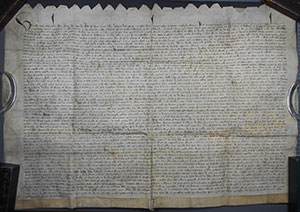
Other documents were compiled and retained as a result of standard practices of the time, and their appearance within the royal archives can be explained much more easily. Very few records relating to the medieval archiepiscopal estates survive within the archbishops’ own archive, but during vacancies those estates were taken into royal hands, and a number of detailed accounts and other related documents compiled during those periods survive, giving insights into archiepiscopal revenue and administration not available from the archdiocese’s own records.
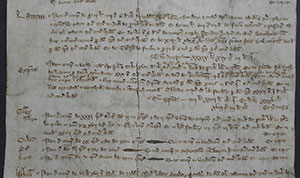
But the royal archive really comes into its own when its records can be used in close conjunction with the registers, offering an alternative point of view to an event or providing further details. For instance, large sections of each register relate to the institution of clergy or the confirmation of elections and appointments of abbots, priors and other higher clergy. Many of these involved the crown, as the patron of benefices or in assenting to elections, and the numerous pieces of parchment which made their way backwards and forwards between Westminster, York and other relevant bodies for each appointment can often be traced across the various archives. Licences to elect were sought and issued, details were sent to both king and archbishop, assent was requested and given (or not), and orders directed to officials to enact decisions, and to safeguard, administer and return lands and income. The process was complex, but did produce plenty of paperwork for modern historians to use.
Of course, archbishops also regularly sent their own personal correspondence to the Crown, giving information or requesting assistance or favours. These could also set in motion a whole chain of administrative processes, many of which were documented in writs or warrants and ften culminated in orders enrolled in the chancery rolls, which essentially recorded, usually in abbreviated form, letters which were issued from the king’s main writing office, the chancery. These are some of the most useful documents for historians of all kinds, and some of the most accessible, since many are available through printed calendars. Taxation of the clergy produced huge amounts of paperwork, from the negotiations for their agreement through to their collection and accounting. Some parts of this process can be found in the registers, such as correspondence with the other northern bishops and the appointment of local collectors, but the royal records contain far more, from the initial correspondence between the crown and the clergy through to the financial and administrative records of each tax, and even the receipt of the cash in the Exchequer.
The royal archive contains many other gems which have survived often by complete chance. To cite just one relatively well-known example, in 1388 a petition from ‘friends’ of Archbishop Alexander Neville complained how ‘libellous bills’ had been pinned up around the capital during a session of parliament. They included copies of these bills with their complaint, and one of these is probably a document which survives elsewhere in The National Archives, written in English in a northern dialect and forming a devastating attack on Neville’s character, describing him as a tyrant, a thief and a traitor who had brought extortion and destruction to the land.
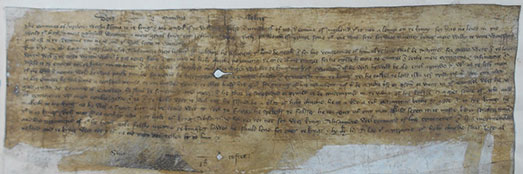
These strong connections between the royal and archiepiscopal administrations, and the records they produced, provide a hugely important source for historians looking to trace the business of the northern church and its interactions with the royal government. But this interaction, and the benefits of the records, was something of which contemporaries were also only too aware.
In 1355, when the king needed details of the precise date of Archbishop Melton’s death, he asked both the royal and archiepiscopal authorities for information. On that occasion the king had to rely on his own Exchequer, as, rather surprisingly, Archbishop Thoresby’s clerks replied that that information could not be found in their own records.
However, in 1370, when Thoresby was again asked to check his registers, this time for institutions to the vicarage of Ecclesfield near Sheffield, he was able to reply with full details going back almost 60 years!
You can find out more about The National Archives’ Chancery and Exchequer collections in our YouTube presentations and on our Further Resources page.


